Implicit belief state
A V-JEPA2 ViT-Large encoder, adapted on robotic trajectories, extracts temporal features from historical observations. These features serve as a learned physical and temporal prior.
1 School of Artificial Intelligence, Jilin University2 IO-AI TECH
Grounding the next action in a history of observations.
Real robots. Dynamic environments. YouTube
A single observation does not tell the whole story.
Objects move, views become occluded, and the scene changes. BeliefVLA uses a sequence of past observations to infer an implicit belief state, giving a vision-language-action policy access to temporal context and learned physical priors.
Current-frame semantics and history-derived dynamics meet in a shared representation that conditions continuous robotic actions.
Read the formulation (PDF, opens in a new tab)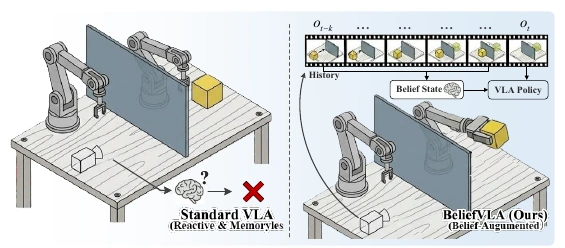
While Vision-Language-Action (VLA) models exhibit remarkable open-vocabulary generalization in robotic manipulation, they remain fundamentally constrained by a structurally reactive paradigm. Inferring actions from static visual representations or simple frame stacking forces policies to learn temporal dynamics from scratch, lacking the physical grounding necessary for robust real-world control. We introduce BeliefVLA, a framework that shifts robotic control from purely reactive mapping to reasoning within a continuous implicit belief state.
By leveraging a Video Joint-Embedding Predictive Architecture (V-JEPA2) to infer these latent states from historical context, BeliefVLA injects dynamics-aware priors directly into the policy. This approach seamlessly integrates physical reasoning and spatiotemporal dynamics without sacrificing the high-level semantic capabilities of foundational VLMs. Extensive experiments establish BeliefVLA’s state-of-the-art performance across simulated and real-world benchmarks. Furthermore, five observation-perturbation tasks explicitly validate its capacity for temporal memory, action-centric features, and physical priors.
A dual-perception architecture: instantaneous visual semantics alongside a dynamics-aware representation of the recent past.
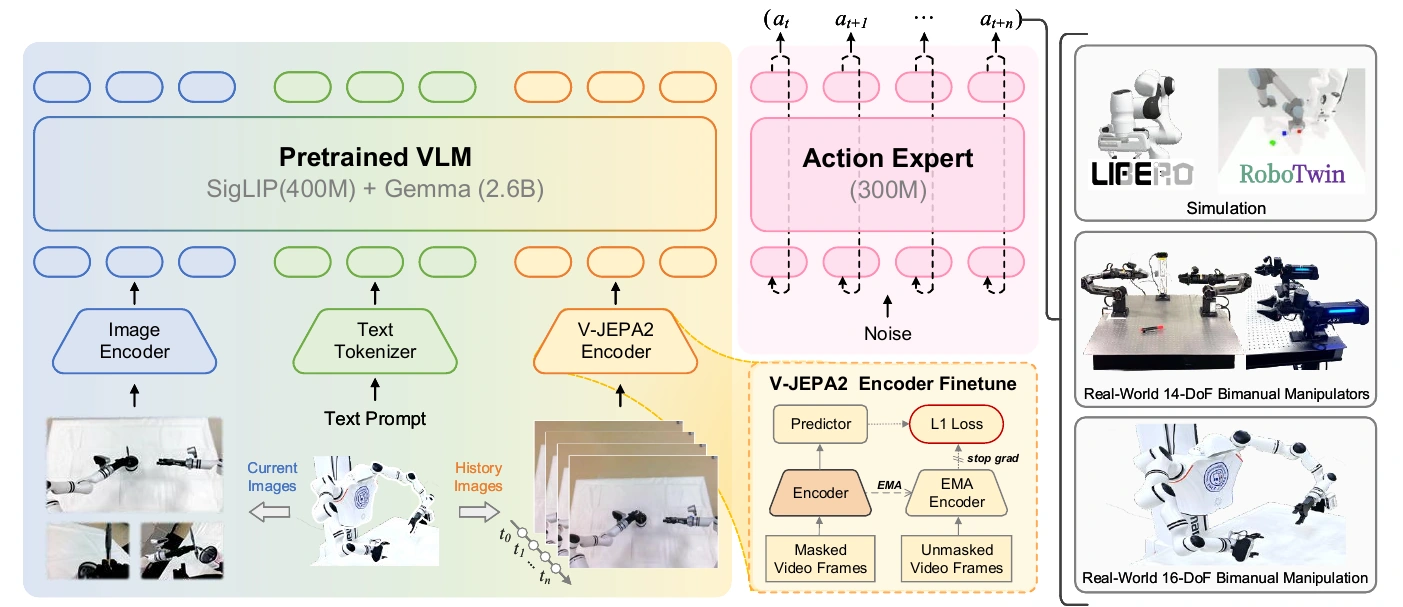
A V-JEPA2 ViT-Large encoder, adapted on robotic trajectories, extracts temporal features from historical observations. These features serve as a learned physical and temporal prior.
Projected belief tokens are concatenated with language and current-frame SigLIP tokens. Bidirectional self-attention in PaliGemma integrates these complementary representations.
A 300M-parameter action expert uses conditional flow matching to refine Gaussian noise into multi-step motor commands, conditioned on the fused representation.
First, adapt V-JEPA2 with masked latent prediction on LIBERO, RoboTwin, and RealSource World data. Then freeze the adapted encoder and jointly fine-tune the VLM fusion layers and action expert. The VLM and action expert are initialized from π0.5.
§ III-D ↗Two simulation benchmarks. Three physical platforms. Eleven real-world tasks. Results below are those reported in the supplied paper.
Success rate (%) across four task suites; averaged over three random seeds.
| Model | Spatial | Object | Goal | Long | Average |
|---|---|---|---|---|---|
| Diffusion Policy | 77.8 | 91.2 | 67.5 | 49.8 | 71.6 |
| Octo | 78.9 | 85.7 | 84.6 | 51.1 | 75.1 |
| OpenVLA | 84.7 | 88.4 | 79.2 | 53.7 | 76.5 |
| SpatialVLA | 88.2 | 89.9 | 78.6 | 55.5 | 78.1 |
| CoT-VLA | 87.5 | 91.6 | 87.6 | 69.0 | 83.9 |
| π0 | 96.8 | 98.8 | 95.8 | 85.2 | 94.2 |
| π0.5 | 98.8 | 98.2 | 98.0 | 92.4 | 96.9 |
| OpenVLA-OFT | 97.6 | 98.4 | 97.9 | 94.5 | 97.1 |
| BeliefVLA Ours | 98.8 | 98.6 | 97.3 | 94.2 | 97.2 |
Highest average among the compared methods. Bold marks the best value in each column, including ties.
Average success rate (%) across eight representative bimanual tasks.
| Model | Easy | Hard |
|---|---|---|
| Diffusion Policy | 24.4 | 1.0 |
| ACT | 20.5 | 1.3 |
| RDT | 14.3 | 4.4 |
| π0 | 20.3 | 8.1 |
| π0.5 | 33.1 | 14.1 |
| BeliefVLA Ours | 40.9 | 21.0 |
50 clean demonstrations per task; 100 evaluation rollouts per task in each setting. Easy matches the training environment; Hard introduces domain randomization. No in-domain large-scale pretraining. Gains over π0.5: +7.8 pp (Easy), +6.9 pp (Hard).
30 independent rollouts per setting with matched training data and fine-tuning protocols.
| Task | π0.5 | BeliefVLA |
|---|---|---|
| General manipulation | ||
| Fold box | 66.7 | 73.3 |
| Organize pen | 56.7 | 73.3 |
| Stack cups | 86.7 | 93.3 |
| Stack cubes | 66.7 | 80.0 |
| Fold cloth | 83.3 | 83.3 |
| Uncap pen | 50.0 | 66.7 |
| General average +10.0 pp | 68.3 | 78.3 |
| Observation perturbations | ||
| Dynamic adaptation | 43.3 | 66.7 |
| Field-of-view occlusion | 43.3 | 53.3 |
| Illumination variation | 63.3 | 80.0 |
| Spatial perturbation | 46.7 | 66.7 |
| Background variation | 63.3 | 70.0 |
| Perturbation average +15.4 pp | 52.0 | 67.3 |
Values are success rates (%). Aggregate BeliefVLA rates and gains follow § IV-B. The π0.5 averages use the success counts implied by Figure 4 and 30 rollouts per task, rounded after averaging. pp denotes percentage points.
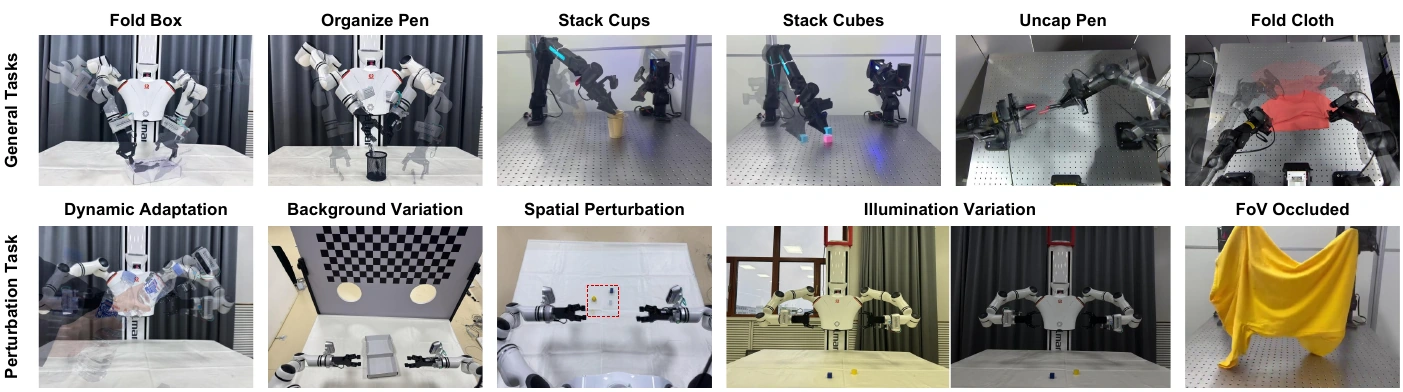
Five controlled perturbations probe temporal memory, action-relevant representations, and physical priors.
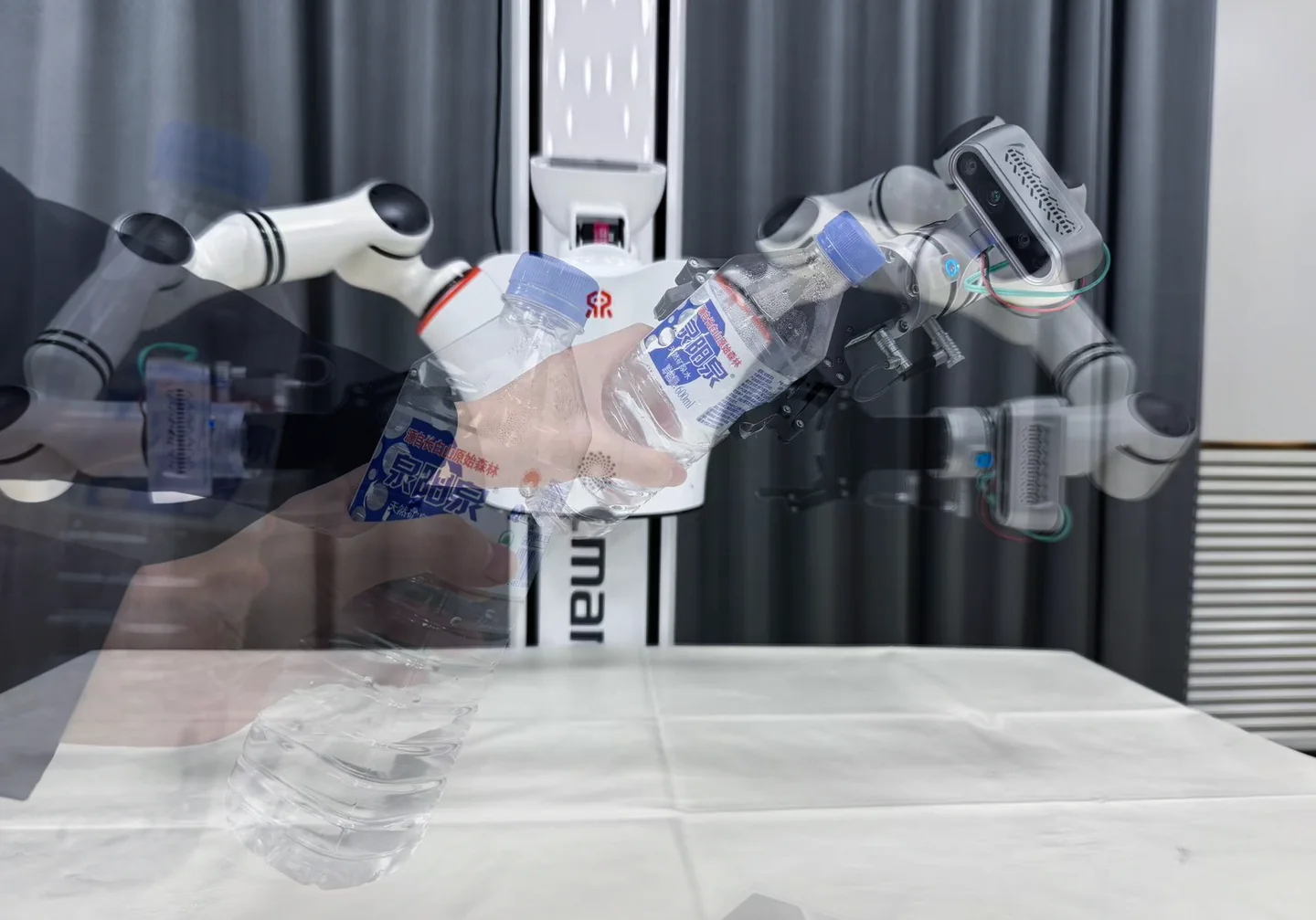 Temporal memory
The target moves continuously during a human-to-robot bottle handover. Observation history supplies context about its motion.
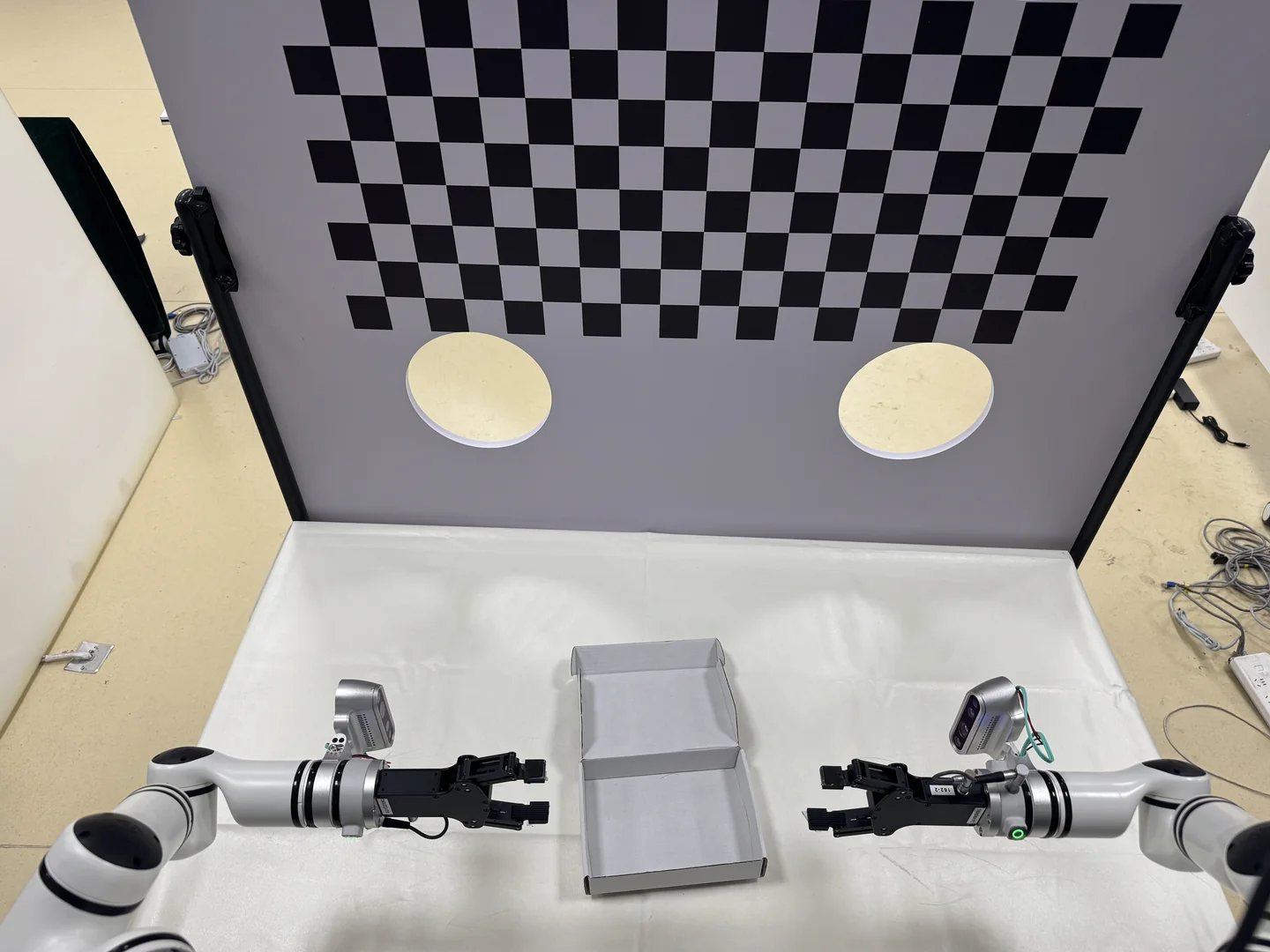 Action-relevant representations
The background changes from the training curtain to a textured calibration board, testing resilience to irrelevant visual changes.
 Physical priors
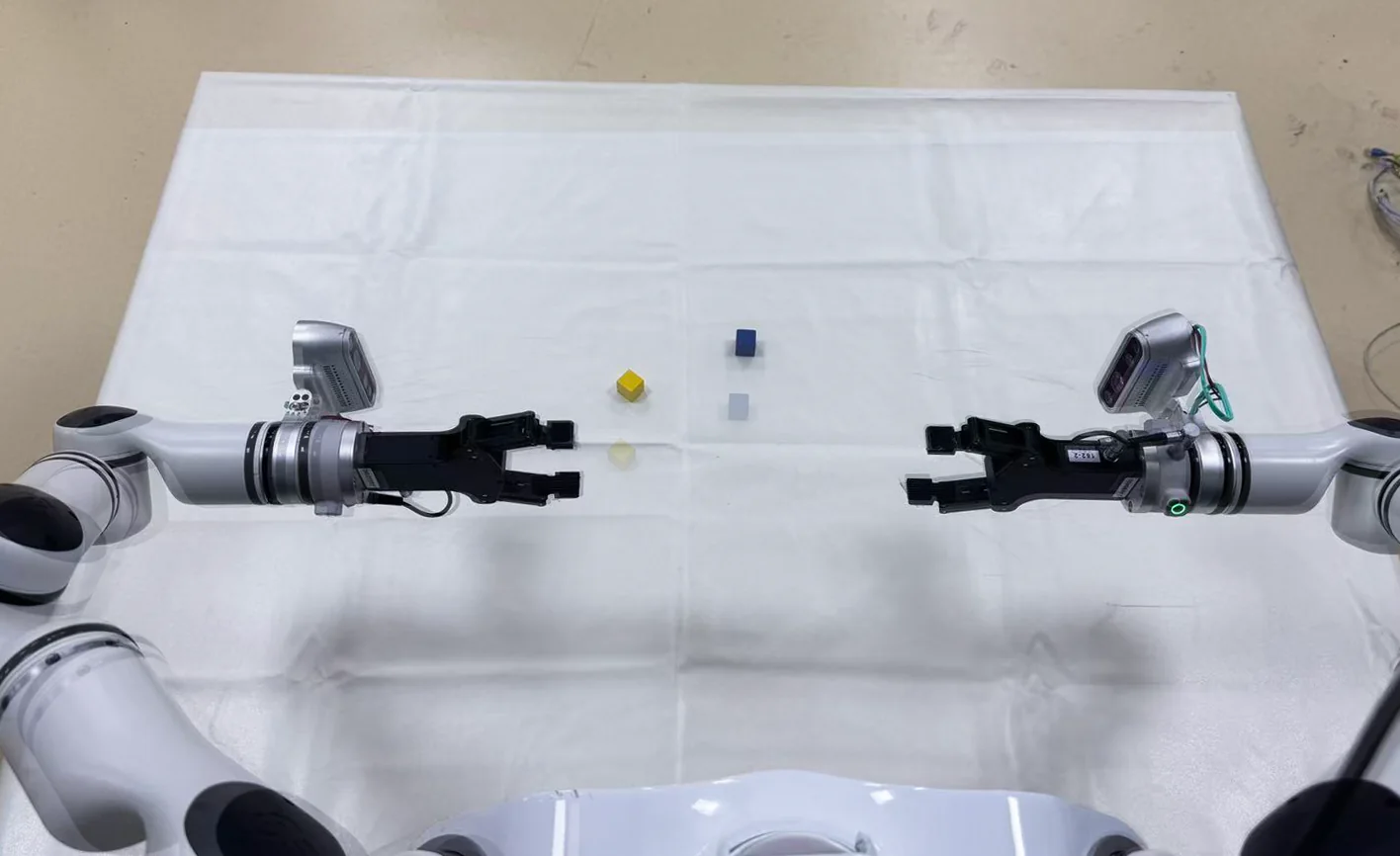
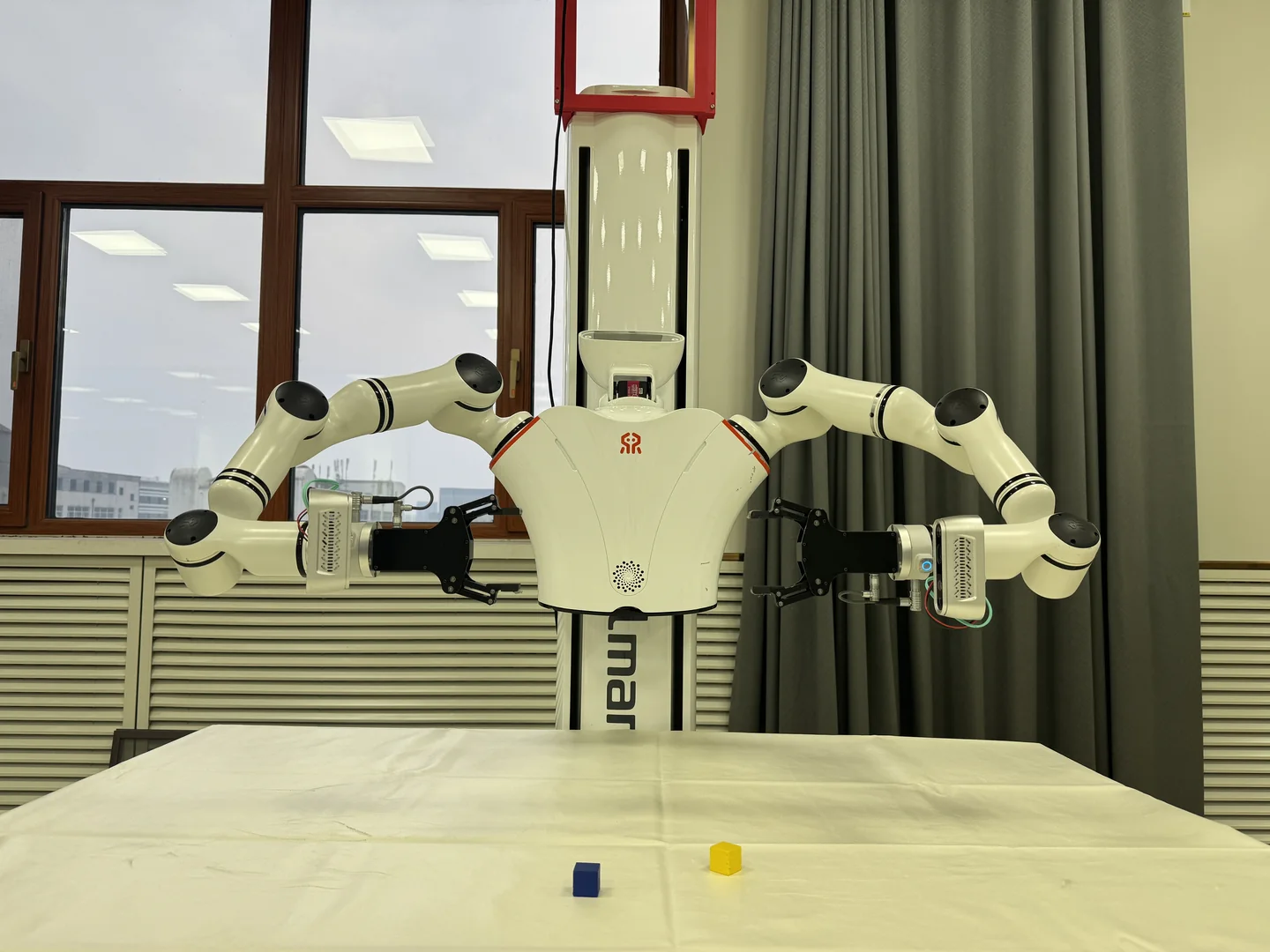
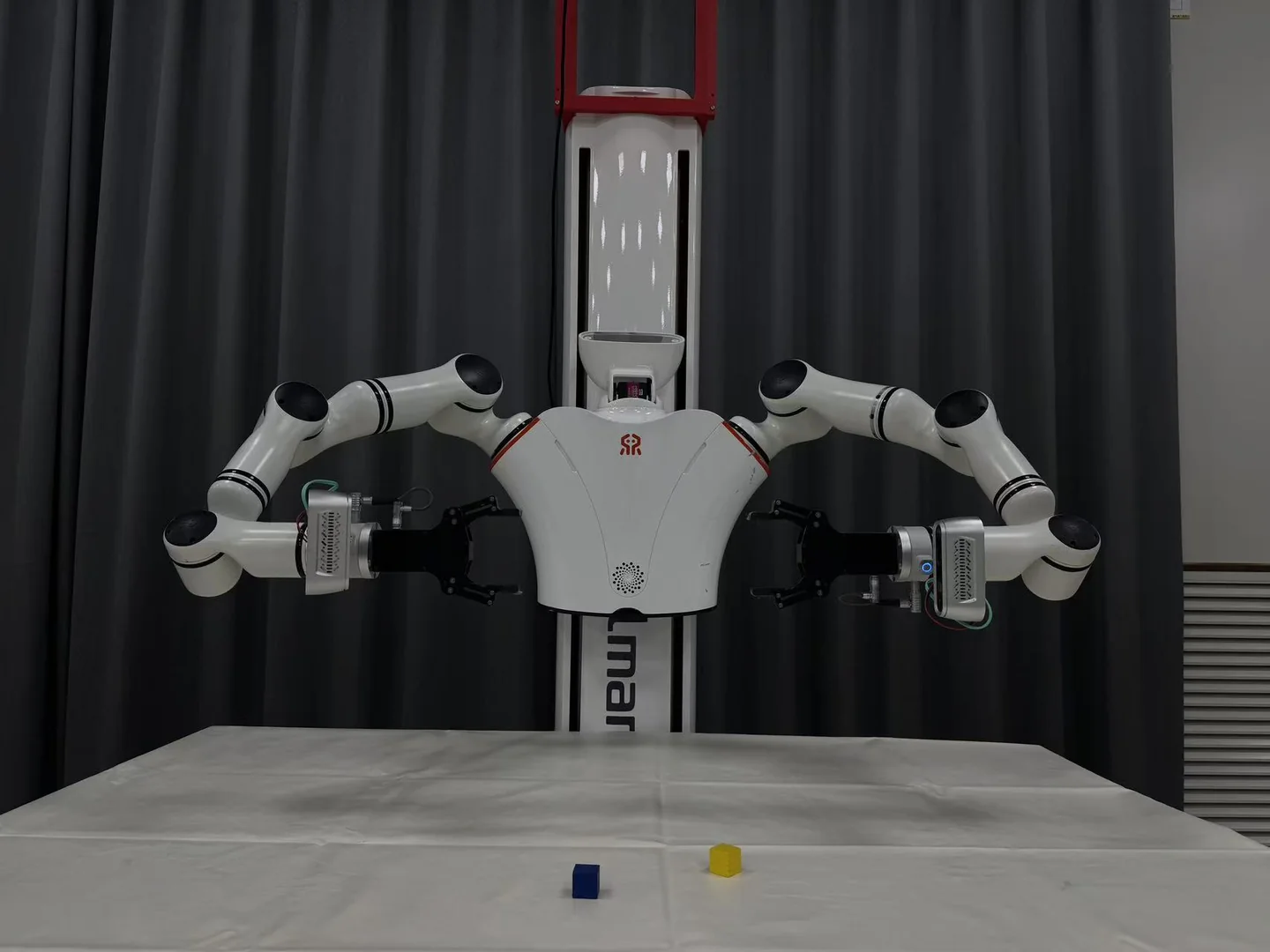
The initial relative position of the robot base and target object is shifted, testing spatial generalization under changed geometry.
 Action-relevant representations
Morning, noon, and evening trials test robustness to natural lighting fluctuations across the same workspace.
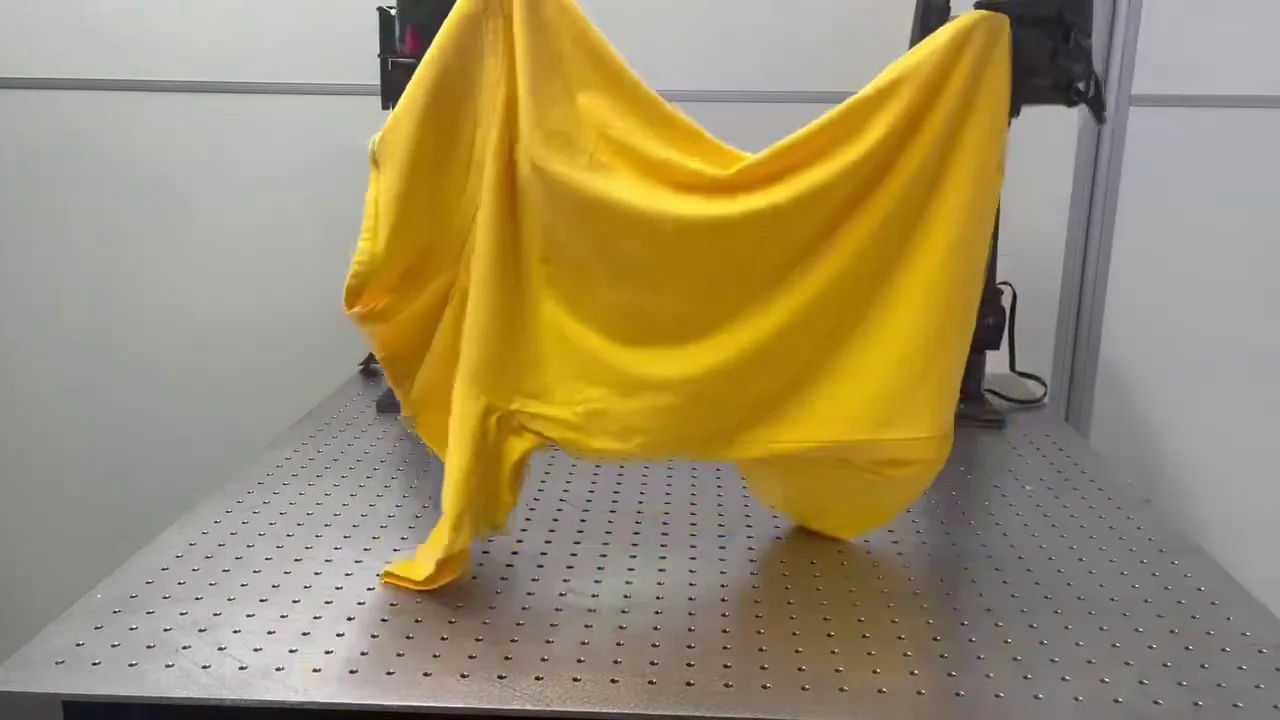 Temporal memory
A large garment intermittently obstructs the base camera during complex cloth folding, making the current observation incomplete.
Success rates from Figure 4(b), with 30 independent rollouts per setting. Experimental protocol ↗ (PDF, opens in a new tab)
Ablations isolate the belief representation, domain adaptation, and multimodal fusion strategy.
| Model variant | RoboTwin | LIBERO | Cube stack |
|---|---|---|---|
| Without V-JEPA2 (π0.5) | 33.1 | 96.9 | 66.7 |
| Without domain adaptation | 36.0 | 97.1 | 73.3 |
| Causal, belief-isolated fusion | 17.0 | 94.5 | 46.7 |
| BeliefVLA Full model | 40.9 | 97.2 | 80.0 |
Success rate (%). RoboTwin reports the average over eight tasks; Cube stack is a real-world task. Table III · p. 7 ↗ (opens in a new tab)
The paper reports approximately 20 Hz pure inference for BeliefVLA, compared with approximately 25 Hz for π0.5. This is model inference frequency, rather than an end-to-end robot control guarantee.
Belief inference uses a fixed-length observation window, which can limit longer-horizon memory. The additional V-JEPA2 encoder also increases training and deployment cost. Persistent memory is a direction for future work.
Find the full method, protocols, and comparisons in the manuscript.
Read the full paper (PDF, opens in a new tab)@misc{liu2026beliefvla,
title = {BeliefVLA: Implicit Belief-State Driven
Vision-Language-Action Models for
Robust Manipulation},
author = {Liu, Yu and Huang, Tianlv and Han, Wei
and Guo, Hetian and Miao, Chengyu and Yan, Fei
and Fan, Zipei and Song, Xuan},
year = {2026},
note = {Manuscript}
}Manuscript citation; no publication venue or DOI is specified.